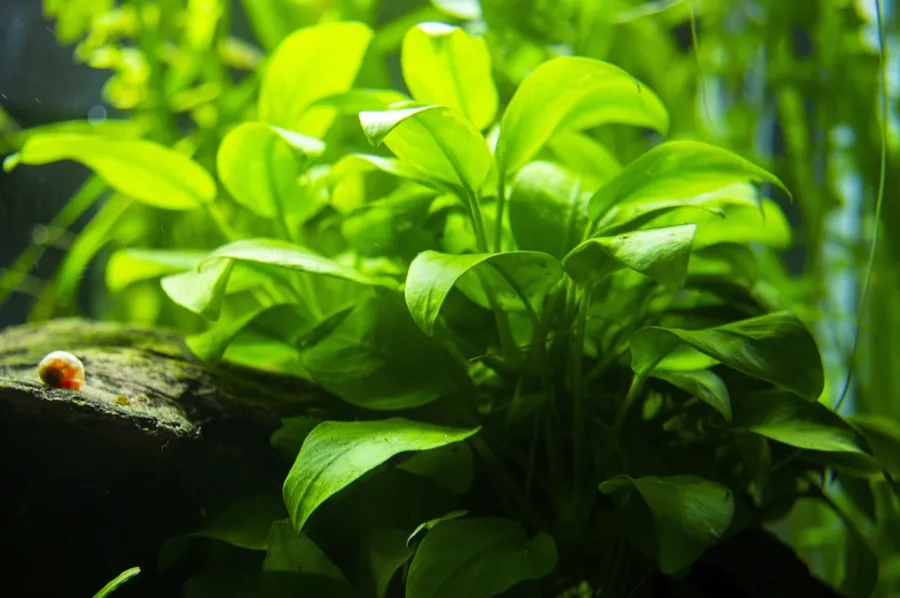
Eight records written, and the schema below is what they carry
A species database that publishes records only after verifying them fills a silo slowly, and this one started with hornwort, the most searched plant on our list, followed by java fern, which three of our animal records had already named, and java moss, which six of them had. Those three were chosen the same way, as a plant our own sources brought up while describing a fish or a shrimp. The three after them were chosen for what they settle: anubias for the light figure every source publishes differently, water sprite for the care sheet carrying another plant’s name in its box, and water wisteria for two light ranges that do not touch. The page you would usually get here, a grid of plant photos with fifty words each, ranks for a while and helps nobody. This one tells you what exists, what is coming, and what the record on each one carries.
A plant record carries different fields
Fish records answer does it fit and who can it live with. Plant records answer will it grow in my tank, which is a different question with different fields. Nine of them, listed below with the blank rule that governs all nine, and every plant record here follows them in this order.
- Light
- Low, medium or high, stated as a demand rather than a lumen figure, because tank depth changes what a fixture delivers.
- CO2
- Required, beneficial or unnecessary. The single field that decides whether a plant belongs in a beginner tank.
- Placement
- Foreground, midground, background or floating, which is the plant equivalent of the water column field on a fish record.
- Substrate
- Rooted in soil, sand tolerant, or attached to hardscape rather than planted at all. It is the field that decides whether a plant can go in the tank you already have.
- Growth rate
- How often you will be trimming, which is the field that turns a plant from an asset into a chore.
- Propagation
- How it multiplies: runners, cuttings, rhizome division or plantlets on the leaf edge.
- Temperature
- The same field as on a fish record, so a planted community can be checked for overlap in one pass.
- pH
- The other figure every animal record already carries, for the same reason: a plant and the fish above it have to want the same water.
- Eaten by
- Which animals in our records will graze or dig it up, cross linked both ways.
- Not recorded yet
- The same rule as everywhere else on the site. A field with no verified source stays visibly empty.
Why aquarium plants come after the fish
The fish records came first for a reason
Every plant question a keeper has is downstream of the animals in the tank: what will get eaten, what will get dug up, what light the fish can tolerate.
Plant sources disagree more, not less
Light and CO2 requirements vary between growers who all keep the plant alive. That needs the same treatment as our betta disagreement: both positions printed.
The cross links matter more than the pages
A plant record is worth writing once it can say which of our animals will eat it. That is why this silo follows the fish silo rather than racing it.
What the animal records already say
The animal records were talking about plants before this silo had one. These six state something that shapes a planted tank, and every line below is on one of those pages with its source named.
| Record | What it says | Why it says it |
|---|---|---|
| Betta | Live or silk plants | Cover, and a leaf to rest on. Silk is accepted, so this is a requirement about structure rather than about botany. |
| Ember tetra | Plants and a dark substrate | The setting the source describes for the species, and the condition under which the color it is bought for actually appears. |
| Cherry shrimp | Cholla wood and moss | Cover while molting. Wikipedia separately states the species does not eat vascular plants, so a planted tank is safe from it. |
| Nerite snail | Will only eat the decaying parts of a plant | Shrimp Science, which is the closest thing on this site to an answer to will it eat my plants. |
| Otocinclus | Driftwood and catappa leaves | Surfaces that grow the biofilm it grazes. The same source names a planted tank among what it wants, and the fish grazes algae off the leaves rather than the leaves. |
| Kuhli loach | Soft sand, so it can bury | Not about plants directly, and it decides them anyway: a substrate soft enough to bury in is a substrate a rooted plant has to hold in. |
Read down the middle column and the shape of the eaten by field is already visible. Two records ask for plants as cover, two state what will not be eaten, one grazes what grows on them, and one decides the substrate for everything else. A plant record joins that conversation rather than starting it, and the first one joined it by printing two sources that cannot agree whether goldfish eat the plant or should be kept away from it. The second closed the same question rather than reopening it: four of its seven sources name goldfish among the animals java fern survives, and one of them says why, that the leaves contain chemicals that taste bad. The third is the third possible answer, which is silence: not one of its seven sources mentions goldfish for java moss in either direction, so that row stays blank.
Questions about aquarium plants for beginners
Why are there only five plant records here?
Because a plant record is worth writing once it can say which of our animals will eat it, and that needed the animal records first. Hornwort shows why that order was the right one: its eaten by row prints one source stating that goldfish do not eat it and another stating that goldfish should be kept away from it, and we hold a record for that fish. Java fern is the second, and it is the record where that question finally has one answer. Java moss is the third, and it is the one our own records had already named six times before we could describe it. Anubias is the fourth and water sprite the fifth, and between them they give the goldfish question its third and fourth answers: two sources on anubias say a goldfish will leave it alone, and three on water sprite say it will not. Publishing a grid of plant photos with fifty words each instead would rank for a while and help nobody.
Which plants are written, and which is next?
Hornwort, java fern and java moss, anubias and water sprite are written, in that order, which is roughly the order of how often they are searched. Water wisteria is next, and it is the plant our water sprite record spends a station comparing against, because one of that record’s own sources prints water wisteria’s scientific name in its stats box for water sprite.
Will my fish eat my plants?
For the animals we hold records on, the table above is the whole answer. Shrimp Science states nerite snails will only eat the decaying parts of a plant, and Wikipedia states cherry shrimp do not eat vascular plants. The otocinclus grazes the algae growing on a leaf rather than the leaf. Nothing we hold describes any of our fish damaging healthy growth.
Do I need live plants at all?
Two records ask for cover and one of them accepts silk. The betta record names live or silk plants for cover and a resting leaf, and the ember tetra record names plants and a dark substrate as the stated setting. Neither source asks for a planted tank as a project.
Do I need CO2?
All three records answer it the same way, which is no. Three of the five sources on hornwort state that CO2 is not needed and two add that the plant grows faster and denser with it. Four of the seven on java fern state it and none of them asks for it, and on java moss one source gives a dose of 15 to 30 ppm and says in the same sentence that the effect is not very significant. All three are beneficial on the three way scale above, so the field that was supposed to decide whether a plant belongs in a beginner tank has not yet excluded anything. What this page will not do is answer it in general, because required, beneficial and unnecessary are three different answers and they belong to individual species.
What light do aquarium plants need?
Our schema records it as low, medium or high rather than as a lumen figure, because tank depth changes what any fixture delivers at the substrate. That is a deliberate limit: a number that ignores depth is worse than a category that admits it. All five records so far have justified it. Our anubias record carries two sources publishing PAR ranges that meet at a single number, 20, and share nothing else, and our newest, water sprite, carries two that agree almost exactly at 50 to 80 while the other three publish no figure at all. The java fern record carries two sources publishing PAR where one's recommended floor sits above the other's ceiling, and neither figure is on the page. The java moss record has one source publishing 10 to 30 PAR and six describing the same plant in words that range from no light at all to direct sunlight.
Can I plant in sand?
It is one of the three values the substrate field will carry, and one of our animal records already constrains it. The kuhli loach asks for soft sand so it can bury, which is a substrate a rooted plant has to hold in.
Are moss balls plants?
They are on the queue below and we have written nothing about them, so this site has no answer. It is worth flagging because the honest version of that question has a legal and ecological angle in some places, and neither is something to improvise.
Will plant records use the same fields as fish?
One field is shared, temperature, so a planted community can be checked for overlap in a single pass against the chart on the water and health page. The other eight are different, because will it grow in my tank is a different question from does it fit.
How fast will the rest of the silo arrive?
One record at a time, at the standard the animal records set: every field from a named source, the disagreements printed, the blanks left blank. Plant sources disagree about light and CO2 more than fish sources disagree about temperature, and that is the part that takes the time. Hornwort took five sources, and they published four different light demands and two photoperiods that do not match.
What is not here yet
Seven plant records in the queue
Hornwort, java fern and java moss are the three most searched plants on our list, within about two thousand searches a month of each other. All three are written: hornwort, java fern and java moss. Anubias was next and is now written, which was overdue: three of our animal records name it. None of the names below is linked, because none of them exists yet.
The plants our records already name, and who names them
This silo holds three plant records. What it can hold without writing the rest is the list of aquarium plants that the animal records already name, because their sources named them while describing a fish.
None of these is a plant record. Each is a plant a care source recommended for a specific animal, transcribed onto that animal's page with the source attached. That is a weaker claim than a record and a much stronger one than a stock list of easy plants.
Java moss is named more often than anything else
Read the table across and one plant leads by a distance: java moss is named on six of our records, and by five sources we can name, Aquarium Co-Op, Aquarium Source, PetMD, Splashy Fish and FishLab. Anubias, java fern and amazon sword are on three each and nothing else is on more than two. No source we hold states any plant as a requirement for any animal, which is why none of this is in a field.
The one thing worth knowing before buying either of the top two
Aquarium Store Depot states it plainly for anubias: never bury the rhizome in substrate or it will rot, and rhizomes should be left above substrate when planted. Both plants have to be tied or glued to hardscape instead, with the rhizome left above the substrate, and the same source says anubias will happily grow even in bare bottom tanks. Corrected on 3 September 2026: this paragraph previously presented a sentence about epiphytes as a quotation from that source. The instruction is what the source publishes; the wording was ours, and the two Aquarium Store Depot pages we cite do not use the word.
Each of those two is named on three of our records, and both now have a record of their own: java fern spends a station on this single instruction and our anubias record spends two, because on that plant our sources agree about the rhizome and disagree about whether the roots may sit in the substrate. The instruction stays on this page anyway, because a reader who buys either plant on the strength of the table above and buries it has followed our recommendation into the one failure the sources agree about.
What a plant record will have to hold that a fish record does not
Light and substrate, and the hornwort record proves the point twice over: its substrate row is the word none, because the plant has no roots to put in any. Aquarium Store Depot publishes a pH and hardness band per plant, the same shape as a fish record, and adds low light for the marimo moss ball with a temperature range of 60 to 80 °F and pH 6.0 to 8.0. That is the field set this silo uses, and it is why plant records are not simply fish records with a different subject.
| Plant | Named on | On this site |
|---|---|---|
| Java moss | Kuhli loach, otocinclus, guppy, ember tetra, corydoras, ghost shrimp | written |
| Anubias | Kuhli loach, otocinclus, corydoras | written |
| Java fern | Kuhli loach, otocinclus, angelfish | written |
| Cryptocoryne | Kuhli loach, otocinclus | queued |
| Amazon sword | Kuhli loach, otocinclus, angelfish, and the bristlenose pleco eats it | queued |
| Vallisneria | Otocinclus | queued |
| Hornwort | Ember tetra, oscar | written |
| Water sprite | Dojo loach, guppy | written |
| Duckweed | Guppy | queued |
| Guppy grass | Guppy | queued |
| Anacharis | Ember tetra, angelfish | queued |
Two of the ten were not in the queue when this table was first drawn: guppy grass, named after a fish we hold a record for, and anacharis. Both are in it now, and they got there because the fish that needed them named them rather than because of a plan for the plants. One name on the table is now there for the opposite reason. Our bristlenose pleco record carries Aquarium Co-Op saying that while many plecos are safe for plants, bristlenose plecos are known to sometimes snack on sword plants, which makes the amazon sword the first plant here named by a record as food rather than as furniture. That is how the queue finds out what it is missing, and it is also the order the records are being written in. Hornwort was on two of our records before it had one of its own, java fern was on three, and java moss was on six.